
A bedroom has one job: help you rest. Yet it is often the room that ends up with leftover furniture, harsh lighting and not enough storage. These seven rules are the checks we run on every bedroom we design, whether it is a compact master room in Kharadi or a larger one in Nashik.
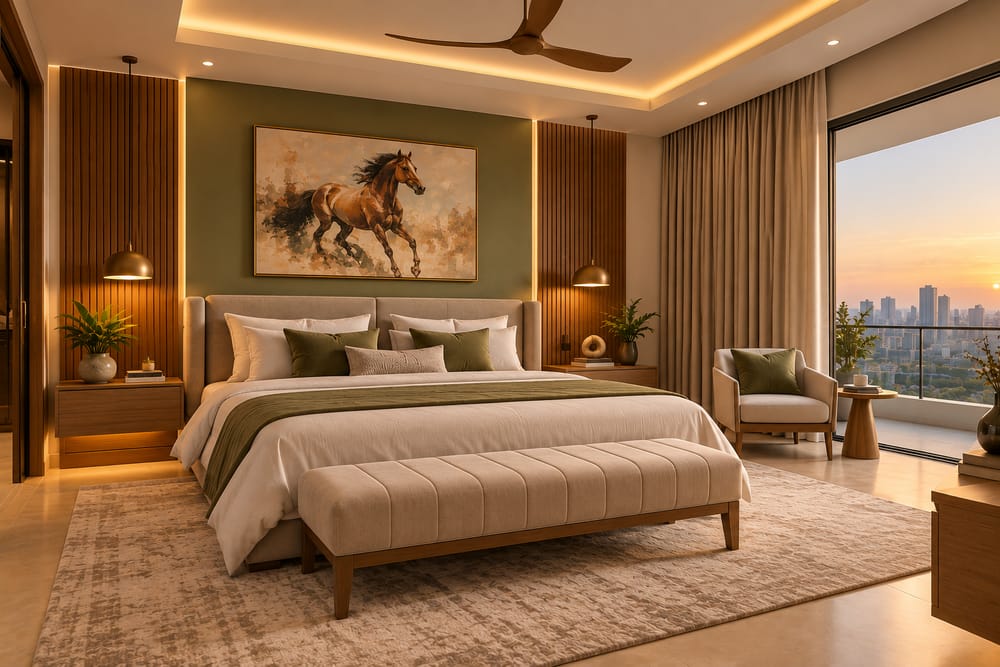
| # | Rule | In one line |
|---|---|---|
| 1 | Layout | Place the bed first and leave room to move |
| 2 | Colour | Calm base, one or two accents |
| 3 | Lighting | Ambient, task and accent layers, all dimmable |
| 4 | Storage | Plan it before decor |
| 5 | Comfort | Good mattress, soft natural materials |
| 6 | Light, noise, air | Design for sleep conditions |
| 7 | Personal touch | A few meaningful items, not clutter |
Rule 1: Start with the bed and the layout
The bed is the largest piece in the room, so place it first and plan everything else around it. Most bedrooms feel right when the bed sits against a solid wall, ideally the one you see when you walk in, rather than directly in line with the door.
- Leave at least 2 to 2.5 feet of clear space on the sides and foot of the bed.
- Check that wardrobe doors and drawers can open fully without hitting the bed.
- Keep bedside tables roughly level with the mattress top, one on each side if the room allows.
In a compact Pune flat bedroom, a slightly smaller bed with better circulation space is usually the better trade.
Rule 2: Keep the colour palette calm
A bedroom is for rest, so choose soft, muted colours for the walls and large pieces: warm whites, beiges, sage, dusty blue or soft grey. Save stronger colours for a headboard wall or small accessories.
The 70-30 rule works well here: about 70% a calm base, 30% one or two accent colours repeated in cushions, curtains, art and a throw.
Rule 3: Layer your lighting
One ceiling light is rarely enough. Good bedrooms combine three layers:
- Ambient: soft general light, ideally dimmable and warm white (2700K to 3000K).
- Task: bedside reading lamps or wall lights, so one person can read while the other sleeps.
- Accent: a cove light, a lit niche or a strip behind the headboard for a relaxed glow.
Put the main switch by the door and a second one by the bed, so you never have to get up to turn the lights off.
Rule 4: Plan storage before decor
Clutter is the quickest way to spoil a bedroom. Decide where clothes, bedding, shoes and luggage go before you choose decor.
- Use a full-height wardrobe to the ceiling instead of leaving dead space on top.
- Choose a bed with hydraulic or drawer storage for bulky bedding and off-season clothes.
- Use sliding shutters in small rooms so doors do not eat into floor space.
- Add a few open shelves or niches for items you like to see, and keep the rest closed.
Rule 5: Invest in comfort and soft materials
The things you touch every day matter more than how they photograph. Spend on a good mattress and quality bedding, then add texture with a rug, curtains and cushions.
- Pick a mattress that suits your sleeping position and back, and try it in person.
- Use natural fabrics such as cotton and linen, which breathe better in warm weather.
- Place a soft rug where your feet land in the morning.
Rule 6: Control light, noise and airflow
A bedroom that looks good but wakes you at 6 am is not working. Plan for sleep conditions as part of the design.
- Combine sheer curtains for the day with blackout curtains or blinds for sleeping.
- Use soft furnishings, a rug and a padded headboard to absorb noise, especially on busy roads.
- Keep cross-ventilation clear, and place the AC so air does not blow directly onto the bed.
- Keep TVs and work desks out of the bedroom where you can, or keep them in a closed unit.
Rule 7: Make it personal, but keep it uncluttered
The best bedrooms feel like their owners. Add a few things you love, such as framed photos, a piece of art, books or a plant, and give each one space. Aim for a few meaningful pieces, not a full shelf of decor. If Vastu matters to your family, plan bed and wardrobe positions early so they fit the layout from the start.
Common mistakes
- Oversized bed or furniture: it makes the room feel cramped and blocks walkways.
- Only a central ceiling light: it flattens the room and is harsh at night.
- Too many strong colours: a bedroom with several competing colours is tiring, not restful.
- Skipping storage planning: loose furniture added later rarely fits well.
- Forgetting the AC and curtains: plan their positions along with the bed and wardrobe.
How we approach bedrooms at Tryakshaay
We start every bedroom with the layout and storage, then choose the palette, lighting and materials, and check the result in 3D previews before work begins. If you would like us to review your bedroom plan, we are happy to walk through it with you.
These are general design guidelines, not strict rules. The right choices depend on your room size, light, budget and habits.