
The short answer You can make a house look expensive without a bigger budget: declutter, layer light properly, choose fewer and better-proportioned pieces, and spend on texture and finish rather than on every surface at once. What matters is where the money goes, not how much you spend overall.
This guide works through lighting, colour, statement pieces, flooring, layout and finishing touches for any home, from a compact city flat to a larger house, and the mistakes that undo an otherwise good plan. The ideas work in any city; if you are in Pune or Nashik, the two cities we serve, our team can plan and build them for you.
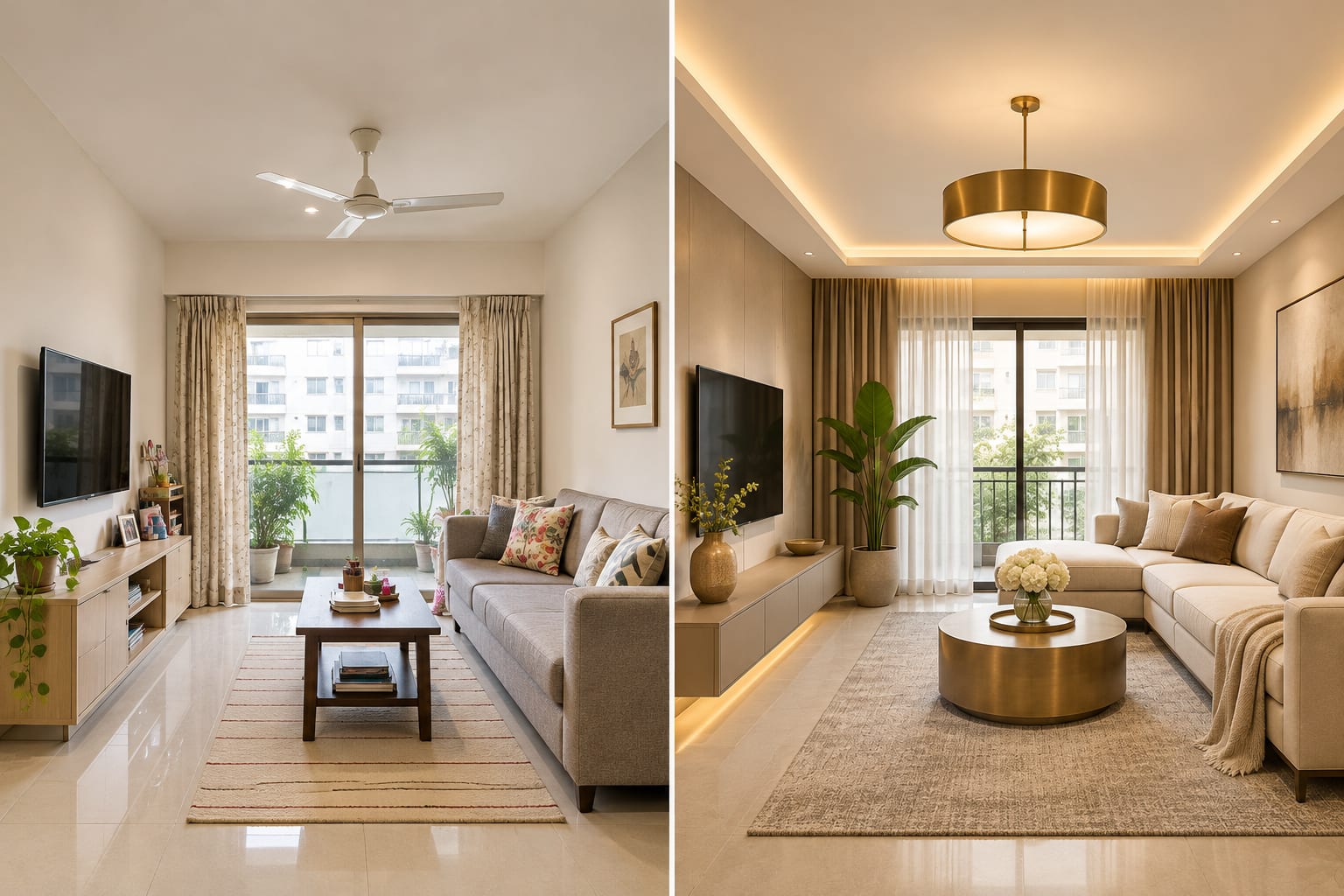
What makes a home look expensive
A room looks expensive when it looks considered, not when it looks costly. Three things usually separate an "expensive-looking" room from an ordinary one: a clutter-free surface, consistent quality of finish, and good proportion between furniture, the room and the people using it. None of these need a large budget — they need editing.
- Clutter-free surfaces: a counter, console or shelf with two or three well-placed objects reads as styled. The same surface with ten small items reads as untidy, however nice each item is on its own.
- Consistent finish, not maximum spend: matching metal finishes (all brass, or all matte black) across handles, taps and light fittings looks more expensive than mixing several finishes bought on separate budgets.
- Proportion over cost: a sofa, rug or light fitting sized correctly for the room looks right even if it is mid-range. An expensive piece that is too small or too large for the space still looks off. Our guide to the 7 basic principles of interior design covers scale and proportion in more depth.
Lighting: the cheapest luxury upgrade
Lighting changes how a room is read faster than almost anything else, and it is usually the cheapest change on this list. A single bright ceiling light flattens a room and makes even good furniture look plain. Layered light — ambient, task and accent — adds depth without adding square footage.
| Light layer | What it does | Typical cost (Pune and Nashik) |
|---|---|---|
| Ambient (ceiling points or a cove) | Fills the room evenly and removes harsh shadows | ₹3,000 to ₹15,000 for extra points or a basic cove |
| Task (floor or table lamps, under-cabinet) | Focused light for reading, counters and desks | ₹800 to ₹4,000 per fixture |
| Accent (wall washers, LED strips) | Adds depth to art, alcoves and TV units | ₹1,500 to ₹6,000 per run |
- Go warm, not cool. Warm white light (around 2700K to 3000K) suits a home far better than the cool white common in offices and showrooms.
- Add a dimmer on the main living and bedroom circuits. A dimmer costs a fraction of a lighting fixture and changes the mood of a room instantly.
- Hide the source, not the light. Cove lighting, under-shelf strips and shaded lamps look more finished than an exposed bulb or tube, even at the same wattage.
Colour and texture on a budget
Paint and fabric are two of the cheapest ways to change how a room feels, and both work best with restraint. A neutral base with one repeated accent colour looks considered. Several competing colours, however nice each one is, looks busy. Our 70-30 rule guide covers this balance in more detail, including room-by-room colour examples.
- Matte over glossy. Matte and textured paint finishes generally look more expensive than glossy ones under normal room lighting, which tends to show every imperfection.
- Add texture cheaply. A linen or cotton throw, a jute or wool rug, a cane headboard or rattan light shade add texture for a fraction of the cost of new furniture.
- Repeat one accent colour in three or more places — a cushion, a vase, a piece of art — so it reads as a deliberate choice rather than one mismatched item.
Statement pieces that anchor a room
One well-proportioned piece per room usually does more than several small decorative items. A good rug, a coffee table, a pendant light or a mirror gives the eye a clear focus and makes the rest of the room feel arranged around it, rather than scattered.
- Pick one anchor per room. In a living room this is often the rug or the coffee table; in a bedroom, the headboard wall or the bedside lighting.
- Size it up, not down. A rug that is too small under a sofa set is one of the most common reasons a living room looks unfinished. For compact flats, our living room interior design guide has size and layout references for common room dimensions.
- Spend more on the one piece people touch or notice first — a door handle, a tap, a light fitting — and save on items further from eye level.
Flooring and wall finishes that signal quality
Flooring and wall finishes cover the largest visible area in any room, so inconsistency here is more noticeable than almost anywhere else. A single good finish, used cleanly, usually looks better than two or three cheaper finishes patched together.
| Finish | Look it gives | Typical cost range (Pune and Nashik) |
|---|---|---|
| Texture or lime-wash feature wall | Depth and warmth without full cladding | ₹60 to ₹150 per sq ft |
| Large-format vitrified tiles | Fewer grout lines, a calmer, bigger-looking floor | ₹60 to ₹180 per sq ft |
| Engineered wood or laminate flooring | Warmth and a furnished feel over plain tile | ₹120 to ₹280 per sq ft |
| Wallpaper on one accent wall | Pattern and texture at a lower cost than cladding | ₹60 to ₹200 per sq ft |
Where the budget is tight, treat one wall or one zone fully rather than spreading a thin finish across every wall in the home. A single well-finished feature wall reads as a choice; a half-done finish everywhere reads as a shortage.
Smart furniture layout and negative space
Open floor space, not furniture, is often what makes a room look expensive. A room packed with furniture, even good furniture, looks smaller and busier than the same room with fewer, better-placed pieces and clear walking paths.
- Leave at least 2.5 to 3 feet of clear walking space around main furniture so the room does not feel blocked.
- Choose fewer, larger pieces over many small ones. A single 3-seater sofa generally looks more settled than a sofa plus several unrelated chairs.
- Pick furniture with visible legs rather than solid bases. Seeing floor underneath a sofa or cabinet makes a room feel more open.
- Align furniture to the room, not the walls. Pushing every piece flush against a wall is not always the most open layout; sometimes angling a sofa or leaving a gap behind it reads as more intentional.
Finishing touches: mirrors, art and accessories
The last 10% of a room, the details added after the furniture is in place, is often what separates a finished-looking room from an unfinished one.
- Use mirrors to add light and depth. A mirror placed to reflect a window or light source makes a room feel brighter and larger without any structural change.
- Hang art at eye level, and group smaller pieces together rather than scattering single frames around a room. A gallery wall of three to five pieces looks more deliberate than five walls with one frame each.
- Keep accessories edited. A tray, a plant and one object of interest on a console looks styled; the same surface with everything the house owns on it does not.
- Match hardware finishes across a room — door handles, curtain rods, photo frames — where you can. Consistency reads as more expensive than variety here.
Common budget-design mistakes to avoid
- Buying many cheap items instead of a few good ones. A room full of small, inexpensive decor pieces usually looks cluttered, not finished.
- Skipping the lighting layers. Relying on one ceiling light and calling it done is the single most common reason a room looks flat despite decent furniture.
- Mixing metal finishes without a plan. Gold, chrome, matte black and bronze together, each bought separately, reads as uncoordinated rather than eclectic.
- Ignoring scale. A rug that is too small, art that is too small for the wall, or a light fitting that is too small for the room are common and easy to fix before you buy.
- Chasing trends over the room's actual size and light. A look that works in a large, bright showroom flat does not always translate to a smaller, darker apartment.
If weighing up all of this against your own flat feels like a lot to plan alone, that is exactly the kind of decision we help with. For full design-and-execution projects, Tryakshaay charges 15% of project cost, covering design and execution, with a free initial consultation and site visit. We commit to the agreed project timeline, subject to no change in scope after sign-off, no natural calamities or extreme weather, and no unforeseen issues outside our control such as society rules on work hours, deliveries or noise. You can also try our cost estimator for a number specific to your flat before deciding where to spend, or contact us for a full quote.
Frequently asked questions
How can I make my house look expensive on a budget?
Focus on lighting, decluttering and one or two quality statement pieces instead of filling every surface. A layered lighting plan, a neutral base with one repeated accent colour, and good proportion in furniture size usually do more for how expensive a room looks than the total amount spent.
What is the cheapest way to make a home look luxurious?
Lighting is usually the cheapest upgrade with the biggest visual effect. Adding a floor lamp, a dimmer or a warm-white light layer costs far less than new furniture and changes how a room reads within minutes.
Does lighting really make a room look expensive?
Yes. A single bright ceiling light flattens a room, while layered ambient, task and accent lighting in warm white tones adds depth and mood, which is one of the clearest differences between a bare-looking room and a considered one.
What colours make a room look expensive?
Light, warm neutrals used across most of the room, with one accent colour repeated in a few places, read as more considered than several competing colours. Matte and textured finishes also look more expensive than glossy ones under normal room lighting.
Is it better to buy a few expensive items or many cheap ones?
A few well-chosen, well-proportioned pieces, such as a rug, a coffee table or a mirror, usually make a bigger difference than many small decorative items. One statement piece per room gives the eye a clear focus; too many small pieces reads as clutter.
Cost figures are general guides based on typical Pune and Nashik market ranges, can differ in other cities, and are not a quote. Actual costs depend on your room size, materials and site conditions.