
The short answer Vastu for home interiors is a set of traditional directional guidelines that a good designer can usually work into a modern layout. The entrance is most often suggested facing north, east or north-east, the kitchen stove in the south-east, the master bedroom in the south-west and the pooja room in the north-east. Most suggestions are about orientation and placement, not style.
Vastu Shastra is a traditional Indian system of directional and spatial guidelines for buildings — where the entrance, kitchen, bedrooms and pooja room commonly sit relative to the compass directions. Applied practically, it does not mean rejecting a modern interior style: most of its common suggestions are about orientation and placement within a room, and a good designer can usually work them into a contemporary layout rather than around it. This guide goes room by room, with the commonly followed guidance for each and how it sits alongside modern design choices in a typical Pune home.
Vastu consultation is one of our services, offered either standalone or bundled with a full design and execution project. Nothing below is a substitute for a personal consultation that looks at your actual plan, plot and entrance; treat it as a starting point for the conversation.
What is Vastu Shastra for Homes
At its core, Vastu groups a home's rooms and features against eight compass directions and corners, each commonly associated with a function: the north-east corner (Ishan) with worship and openness, the south-east (Agni) with fire and the kitchen, the south-west (Nairutya) with stability and the master bedroom, and so on. These associations are a long-standing tradition followed by many Indian households, not an engineering standard, and different practitioners vary in how strictly they apply each rule.
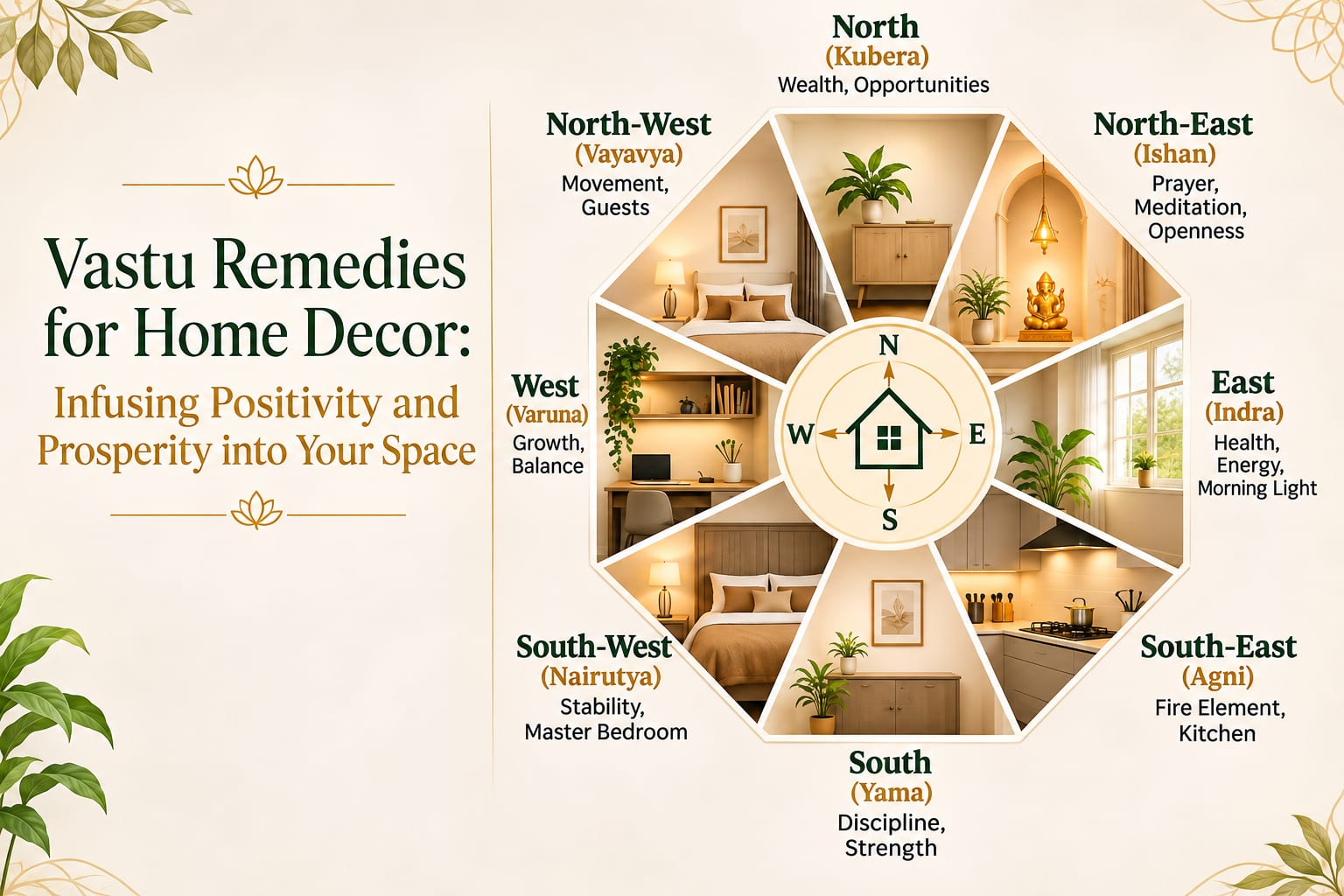
In a builder-developed Pune apartment, the unit's facing, door position and room layout are usually fixed long before you move in, so the realistic goal is rarely a perfect textbook layout. It is choosing which of the common guidelines matter most to your household, and finding workable placements and remedies for the rest — which is where the room-by-room detail below is more useful than a general overview.
Home Entrance: Direction & Placement
The main entrance is where most Vastu conversations start, since it is commonly considered the point where energy enters the home. North, east and north-east facing doors are the directions most often suggested as favourable, with a north-facing home frequently described as the most sought-after orientation in Pune's resale and new-booking market, partly for this reason and partly because north-facing plots tend to get good natural light through the day.
| Entrance direction | Common Vastu view | Practical note for Pune homes |
|---|---|---|
| North | Considered favourable; associated with wealth and opportunity | Often the most requested facing in Pune project bookings |
| East | Considered favourable; associated with health and new beginnings | Gets early morning sun; keep the doorway free of heavy shadows |
| North-east | Considered the most auspicious of the eight directions | Keep this corner of the plot or flat open and uncluttered where possible |
| South or south-west | Considered less favourable by tradition | A well-lit, clean, clutter-free entrance is the usual practical remedy |
Since most apartment buyers cannot choose their unit's facing after the building is designed, the more usable guidance is at the doorway itself: keep the entrance well lit day and night, avoid piling shoes or clutter right at the threshold, keep the door opening smoothly without a creak, and avoid a direct view of a toilet or staircase going down from the main door. A nameplate, a doormat and a pair of healthy plants either side are common, low-cost additions that keep the entrance feeling cared for regardless of which direction it faces.
Kitchen: Direction, Stove & Sink Rules
The kitchen is where Vastu's fire-and-water principle shows up most directly. The south-east corner (Agni, the fire direction) is the placement most commonly suggested for the kitchen itself and for the stove within it, with the cook facing east while cooking. The sink, taps and other water points are usually suggested for the north-east corner of the kitchen, kept at a visible distance from the stove rather than right beside it.
| Kitchen element | Commonly suggested placement | Reasoning given |
|---|---|---|
| Stove / hob | South-east corner, cook facing east | South-east is the fire (Agni) direction |
| Sink / water point | North-east corner | Keeps the water element away from fire |
| Refrigerator | North-west or south corner | Kept apart from the stove, as a stored-food zone |
| Main door of the kitchen | North, east or west | South entry to the kitchen is generally avoided |
None of this rules out a modern modular kitchen. An L-shaped or parallel modular layout can usually place the hob on the south-east counter and the sink on the north-east one without changing the kitchen's overall style, storage or island placement — it is a sequencing decision made at the floor-plan stage, before cabinetry is finalised, which is why we review it alongside the kitchen layout rather than after.
Bedroom: Bed Position & Window Placement
For bedrooms, the most frequently asked Vastu question is where to place the bed. The usual guidance is to place the bed against a solid wall with the head pointing south or east while sleeping, avoid a headboard against the wall shared with a bathroom, and keep the bed out from directly under an exposed beam or a ceiling fan where possible. The master bedroom is commonly suggested for the south-west part of the home, since that corner is associated with stability.
| Bedroom | Commonly suggested zone | Reasoning given |
|---|---|---|
| Master bedroom | South-west | Associated with stability and the head of the household |
| Children's bedroom | West or north-west | Associated with activity and movement |
| Guest bedroom | North-west | Associated with transient, short-term stays |
Window placement follows ordinary daylight and cross-ventilation logic more than a fixed Vastu rule: east and north windows bring in gentler morning light, while a west-facing window usually needs a blind or curtain layer to manage the afternoon sun, which also happens to be good general practice in Pune's climate. Our bedroom design guide covers layout, storage and lighting for the room as a whole; this section only adds the direction-specific points on top of it.
Living Room: Furniture & Energy Flow
The living room is usually suggested for the north, east or north-east part of the home, since it is the space for guests and gathering. Seating commonly faces east or north, heavier furniture such as sofas and TV units sits along the south or west walls, and the north-east corner is kept relatively open rather than filled with a console or cabinet. These placements rarely conflict with a modern seating arrangement — they mostly decide which wall takes the heavy piece and which corner stays visually light.
We cover this in full detail, including a complete placement table and the reasoning behind each suggestion, in our living room interior design guide for Pune flats, which has a dedicated Vastu section alongside the layout, lighting and budget planning for the room.
Pooja Room: Location & Design
The north-east corner (Ishan) is the location most commonly suggested for a pooja room or home temple, since it is considered the most auspicious of the eight directions. Where a separate room is not possible, a dedicated unit or wall niche in the north-east part of a living room, study or passage is the usual practical substitute.
- Face east or north while praying, which usually means placing idols or photographs on the pooja unit's west or south wall.
- Avoid placing the pooja space directly under a staircase, or sharing a wall with a toilet or the kitchen's wet area.
- Keep idols and photo frames at a comfortable standing or seated eye level, not on the floor, and avoid facing two idols directly toward each other.
- A pooja unit inside a bedroom is generally avoided where there is a choice; if the apartment's layout leaves no alternative, screen it from the bed and keep it in the room's north-east corner.
- Use a door or curtain that can close the space off, since a pooja area is usually kept visually distinct from the rest of the room even when it shares the same floor.
Mirrors, Water & Reflective Objects
Mirrors and water features come up often enough in Vastu conversations to deserve their own section, separate from the rooms they sit in.
- Avoid a mirror directly facing the bed. This is one of the most commonly repeated Vastu suggestions for bedrooms; if a wardrobe mirror cannot be moved, a sliding door or curtain that covers it at night is a simple fix.
- North or east walls are usually suggested for mirrors in living rooms and hallways, rather than the entrance-facing wall.
- Avoid a mirror directly opposite the main door. This is said to reflect positive energy back out before it enters the home.
- Water features such as a fountain or aquarium are commonly suggested for the north-east corner of the home, not the bedroom or pooja room.
- Replace or repair a broken or cracked mirror promptly rather than leaving it in place; this applies as much for safety as for Vastu.
Practical Vastu + Modern Design Integration
The most common misconception is that following Vastu means a traditional look, heavy wooden furniture or giving up an open floor plan. In practice, most of the guidance above is about which wall or corner a function sits in, not about colour, material or style — a minimal, contemporary living room can follow the same seating and furniture placement as a traditional one.
Where a plot's fixed facing or an existing layout cannot fully match the textbook direction, the usual approach is a workable remedy rather than a forced renovation: additional lighting in a less-favoured corner, a mirror or a specific colour used deliberately, or simply accepting the trade-off for a direction that matters less to your household. This is the kind of call that is easier to make with a Vastu consultant at the floor-plan stage, alongside your regular interior design meetings, rather than after the kitchen or wardrobes are already built.
How we offer it: Vastu consultation is available standalone or bundled with a full home interior project, starting with a free initial consultation and site visit. For full design and execution projects, it is covered within our 15% of project cost fee, and we commit to the agreed timeline, subject to no scope changes after sign-off, no extreme weather or natural calamities, and no restrictions outside our control such as society rules on work hours or deliveries. You can get a sense of your budget first with our cost estimator, or talk to us about a Vastu-aligned layout for your home.
Frequently asked questions
Which direction should the main entrance face according to Vastu?
North, east and north-east facing entrances are the directions most commonly suggested as favourable, with north-east considered the most auspicious of the three. Most Pune apartments come with a fixed facing decided by the building's layout, so where the direction cannot be changed, the usual approach is to keep the entrance well lit, uncluttered and welcoming instead.
Which direction is best for the kitchen stove in Vastu?
The south-east corner of the kitchen is the direction most commonly suggested for the stove, with the cook facing east while cooking. The sink and other water points are usually suggested for the north-east corner, kept at a distance from the stove, following the general Vastu principle of separating the fire and water elements.
Where should the bed be placed in a bedroom as per Vastu?
The master bedroom is usually suggested for the south-west part of the home, with the bed placed so the head points south or east while sleeping, and never positioned directly under a beam or facing a mirror. These are commonly followed guidelines, and a good room layout can usually accommodate them without compromising the rest of the design.
Can a pooja room be placed inside a bedroom?
It is generally avoided where there is a choice, since a separate north-east corner is the more commonly suggested location for a pooja room. Where an apartment's layout leaves no other option, a dedicated unit or alcove in the north-east part of a room, screened off from the bed, is the usual practical compromise.
Does Tryakshaay offer Vastu consultation, and what does it cost?
Yes — Tryakshaay Interiors offers Vastu consultation for homes in Pune and Nashik, either standalone or bundled with a full design and execution project, starting with a free initial consultation and site visit. For full projects, our fee is 15% of the project cost, and we commit to the agreed timeline, subject to no scope changes after sign-off, no extreme weather or natural calamities, and no restrictions outside our control such as society rules on work hours or deliveries.
Vastu Shastra is a traditional belief system followed by many Indian households; the directions and placements above are commonly cited guidelines, not scientific or legal requirements, and practitioners vary in how they apply them. Check specifics with a Vastu consultant for your own plot and plan.