
The best kids' room design does three things at once: keeps the room safe (rounded edges, furniture anchored to the wall, covered sockets), stays functional for daily life (storage for toys, books, clothes and schoolwork, usually in a modest Pune bedroom), and grows with your child so you are not redoing the room every few years. Most galleries show the finished look and skip the safety planning and the growth question; this guide covers both, along with the budgeting approach we set out in our interior design budgeting guide and the general room rules in our bedroom design guide.
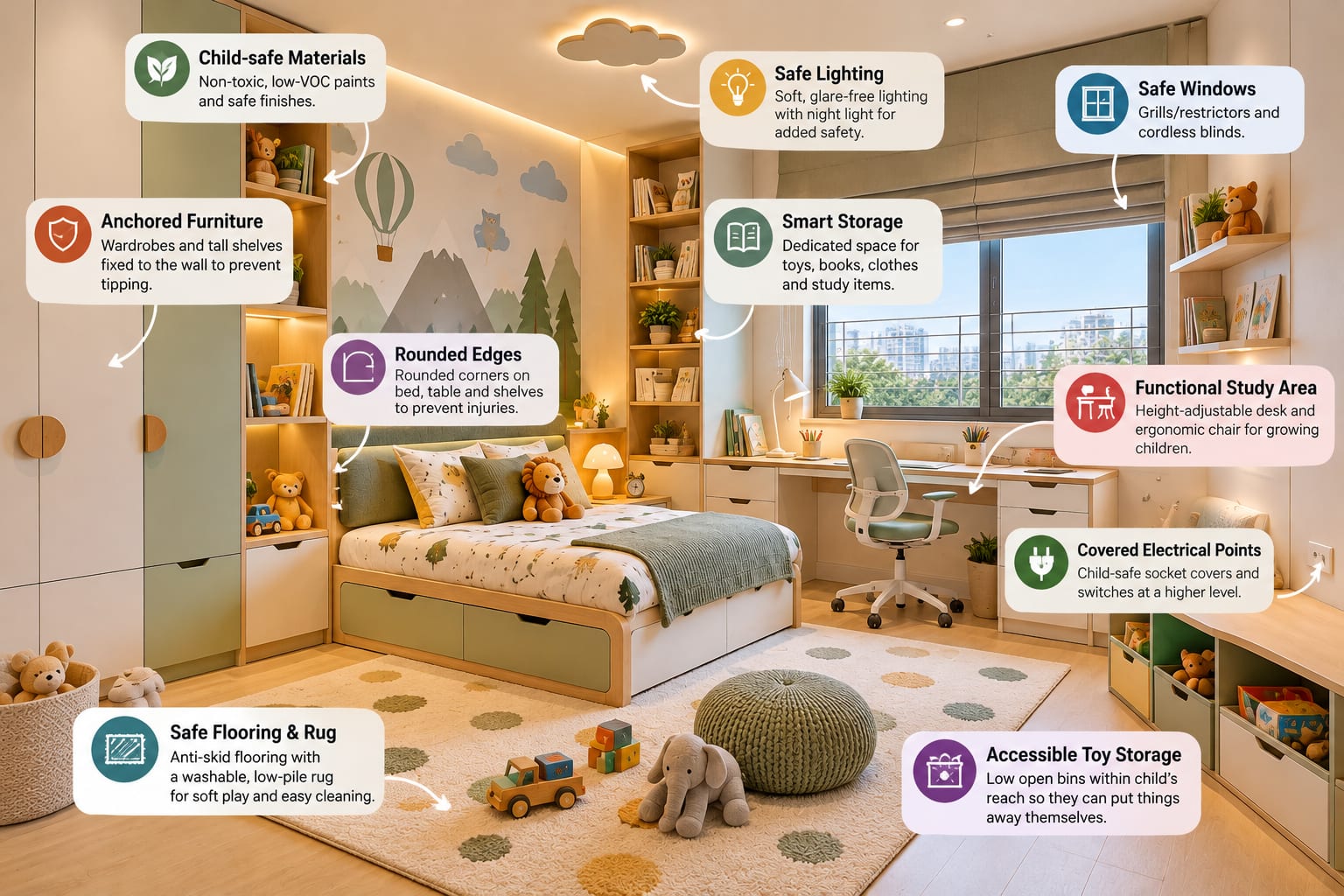
Safety First: Rounded Edges, Sturdy Furniture, Electrical Covers
Safety has to be designed in from the start, not added after with corner guards and socket covers. A kids' room is the one room where a sharp edge, an unanchored wardrobe or an open socket is a daily risk, not a styling choice.
- Round every edge within reach. Choose bullnose or rounded profiles on study tables, bed frames and low shelves. Avoid glass tabletops and sharp-cornered open shelving at a child's height.
- Anchor tall and heavy furniture to the wall. Wardrobes, bookshelves and chests of drawers should be fixed with wall-anchoring brackets so they cannot tip if a child climbs or pulls on a drawer.
- Keep electrical points covered and out of crawling reach. Use child-safe socket covers, route switches at a height toddlers cannot reach, and keep extension cords and loose wiring off the floor.
- Remove cord hazards from windows. Use cordless blinds or a wand mechanism instead of looped curtain or blind cords near the bed or play area.
- Use non-toxic, low-VOC paints and finishes on walls and furniture, since kids spend more close-contact hours in this room than almost anywhere else in the home.
- Check window safety on upper floors common in Pune high-rises: restrictors or grills on openable windows near a bed or play area, and keep furniture away from the window so it cannot be used to climb up.
How we build it: On every kids' room we design, wall-anchoring tall furniture and covering sockets at the carpentry stage is standard, not an add-on. This detailing is included in our 15% of project cost fee for full design-and-execution projects, which also covers a free initial consultation and site visit.
Furniture That Grows: From Toddler to Teen
Redoing a kids' room every three years is expensive and wasteful. The practical fix is to split the room into a fixed "shell" that does not change (wardrobe, flooring, electrical points, storage layout) and a set of age-specific pieces (bed, study chair, desk height, decor) that you swap as the child grows.
| Stage | What to use | What to plan for reuse |
|---|---|---|
| Toddler (1 to 4 years) | Low bed with a guard rail, soft play mat, open low shelves for toys | Keep the wardrobe and storage layout fixed; these stay for every stage |
| Child (5 to 10 years) | Single bed with under-bed storage, an adjustable-height study chair, a fixed desk | Desk and chair should adjust in height rather than need replacing |
| Teen (11 years and up) | A larger bed if the room allows, an upgraded study chair, personalised decor | Only the bed, seating and decor usually need changing at this stage |
- Avoid a top bunk before age 6. Most safety guidance recommends against the top bunk until around that age; use a low bed with a guard rail until then.
- Choose modular wardrobes and bed frames that can be reconfigured rather than replaced outright.
- Pick an adjustable-height study chair and desk from the start, even before formal schoolwork begins, so it is not a separate purchase later.
Storage Design: Toys, Books, Clothes, Study
Clutter shows up fastest in a kids' room, where toys, books, clothes and study material compete for the same floor space. Planning each zone at the design stage keeps the room usable.
| Zone | What goes there | Storage idea |
|---|---|---|
| Toys | Blocks, soft toys, games | Low open bins or a toy chest with a soft-close hinge, at a height the child can reach |
| Books | Story books, school books | A low bookshelf for everyday books, with a higher shelf for ones a parent manages |
| Clothes | Daily wear, school uniform, off-season clothes | Wardrobe with child-height lower drawers and high shelves for off-season items |
| Study | Stationery, files, art supplies | Desk with drawers, a wall-mounted shelf and a pinboard for school notices |
- Keep at least one shelf or bin genuinely within the child's reach, so they can put things away themselves.
- Label bins by category so tidying becomes a task a young child can do independently.
- Reserve closed, higher storage for items a parent manages, such as off-season clothing and keepsakes.
Study Nook in a Small Bedroom: Layout Ideas
A dedicated study spot does not need a separate room. In a typical Pune kids' bedroom, these layouts usually fit without crowding the bed:
- Window-side desk: places the desk where it gets natural daylight during the day, with a task lamp added for evening homework.
- Corner "L" desk: uses a corner that would otherwise sit empty, keeping the centre of the room free for play.
- Desk over or beside a loft storage unit: works in very compact rooms by stacking the study zone under a raised storage or bed platform.
- Wall-mounted fold-down desk: useful before formal study begins, since it can stay folded away and free up floor space for play.
Keep the desk where the bed is not the first thing in view from the chair, so the study zone feels separate from the sleep zone even in a small room. The same desk, chair and legroom basics from our office workstation ergonomics guide apply at a smaller scale here, scaled down to a child's size.
Colour & Walls: Age-Appropriate, Durable Paints
Kids' room walls take more marks, bumps and handprints than any other room, so the finish matters as much as the colour. Use washable, scrubbable paint in a matte or eggshell finish, which wipes clean without showing marks the way a high-gloss finish can.
- Choose low-VOC, child-safe paints, especially for a room with a crib or a toddler who touches the walls often.
- Use the same calm-base, one or two accent colours approach we describe in our bedroom design guide: a neutral base on most walls, with colour on a single feature wall or in soft furnishings.
- Let your child pick an accent colour or two rather than the whole room, so repainting later means one wall, not the whole room.
Flooring & Rugs: Soft Play, Easy Cleaning
Flooring in a kids' room has to handle crawling, spills and years of play, then clean up easily afterward. Vitrified tiles or laminate with an anti-skid finish are a practical base in most Pune homes.
- Add a washable, low-pile rug over the play area for a softer surface for crawling and floor play.
- Avoid high-pile carpet in a kids' room: it holds dust, is harder to clean after spills, and can trap moisture during Pune's monsoon humidity.
- Choose rounded, bevelled tile edges rather than sharp skirting details where furniture meets the floor.
- Keep rugs fixed with a non-slip underlay so they do not shift or bunch underfoot during play.
Two-Kids Sharing: Layout Options for Boys, Girls, Mixed
Two children sharing a room works better when the room is zoned by function rather than split by colour or gender. Give each child their own wardrobe side, shelf and reading light, and personalise with bedding and decor rather than painting half the room one colour and half another.
| Layout | Best when | Key measurement |
|---|---|---|
| Bunk beds | Room is small, both children are 6 years or older | Leave 2.5 to 3 feet of clearance between the top bunk and the ceiling, with side rails |
| Twin beds with a central divider | Room is roughly 10 feet by 10 feet or larger, and some privacy is wanted | A shared storage unit between the beds doubles as a divider and a desk |
| L-shaped bed placement | The room has an irregular shape or an alcove | Beds along two walls free up the centre of the room for shared play |
This works for two boys, two girls or a mixed pair alike: functional zoning matters more than any colour scheme, and it is easier to adjust later as interests move apart.
Frequently asked questions
At what age can kids safely use a bunk bed?
Most safety guidance recommends against letting a child sleep on the top bunk until around age 6, since the fall risk is higher before then. Until that age, use a low bed with a guard rail instead of a bunk.
How do I design a kids' room that works for both a toddler and a teenager?
Fix the parts that are expensive to change: the wardrobe shell, electrical points, flooring and storage layout. Keep the parts that need to change as age-specific and easy to swap: the bed, study chair, desk height and decor. That way most of the room survives each growth stage without a full redo.
What is the best flooring for a kids' room in Pune?
Vitrified tiles or laminate with an anti-skid finish, topped with a washable, low-pile rug for play areas, generally works best. High-pile carpet holds dust and can trap moisture in Pune's monsoon humidity, so it is usually best avoided in a kids' room.
How much storage does a kids' room need?
The exact amount depends on the room size, but plan for at least one full-height wardrobe, a low toy storage unit your child can reach, and dedicated study storage for books and stationery. Deciding this at the design stage works better than adding units later.
Can two kids of different ages and genders share one room well?
Yes. Zone the room by function, such as a shared storage unit splitting two beds, rather than splitting it by colour or gender. Personalise each side with bedding, decor and a reading lamp, and revisit the furniture as the children's ages move apart.
Does Tryakshaay design kids' rooms, and what does it cost?
Yes — Tryakshaay Interiors designs kids' rooms as part of full home projects in Pune and Nashik, starting with a free initial consultation and site visit. Our fee is 15% of the project cost for full design and execution, and we commit to the agreed timeline, subject to no scope changes after sign-off, no extreme weather or natural calamities, and no restrictions outside our control such as society rules on work hours or deliveries. You can get a feel for your own budget with our cost estimator or talk to us directly.
Figures and age ranges in this guide are general planning guidelines, not strict rules or published studies. The right choices depend on your room size, your child's age and your family's habits.